A useful audit should tell you what matters first.
This sample shows how SiteChase can turn technical, local, content, and customer-path evidence into a concise decision sequence—not a giant export of unexplained warnings.
What the evidence suggests—and what it does not prove.
Illustrative example: a Florida service business has a sound foundation but unclear service pathways, inconsistent local signals, and limited proof near high-intent pages.
Clarify service and location relationships
Align verified services, service areas, page structure, and visible business facts before adding more location content.
Strengthen high-intent page pathways
Make the next customer step clearer on mobile: call, request, book, or compare—depending on the real business process.
Resolve crawl and internal-link friction
Validate indexability, canonicals, response codes, crawl depth, and internal paths before treating tool warnings as fixes.
Add answer-ready proof and context
Use visible, verified facts and useful explanations that help customers, search systems, and AI interfaces understand the offer.
Technical evidence becomes useful when it supports a decision.
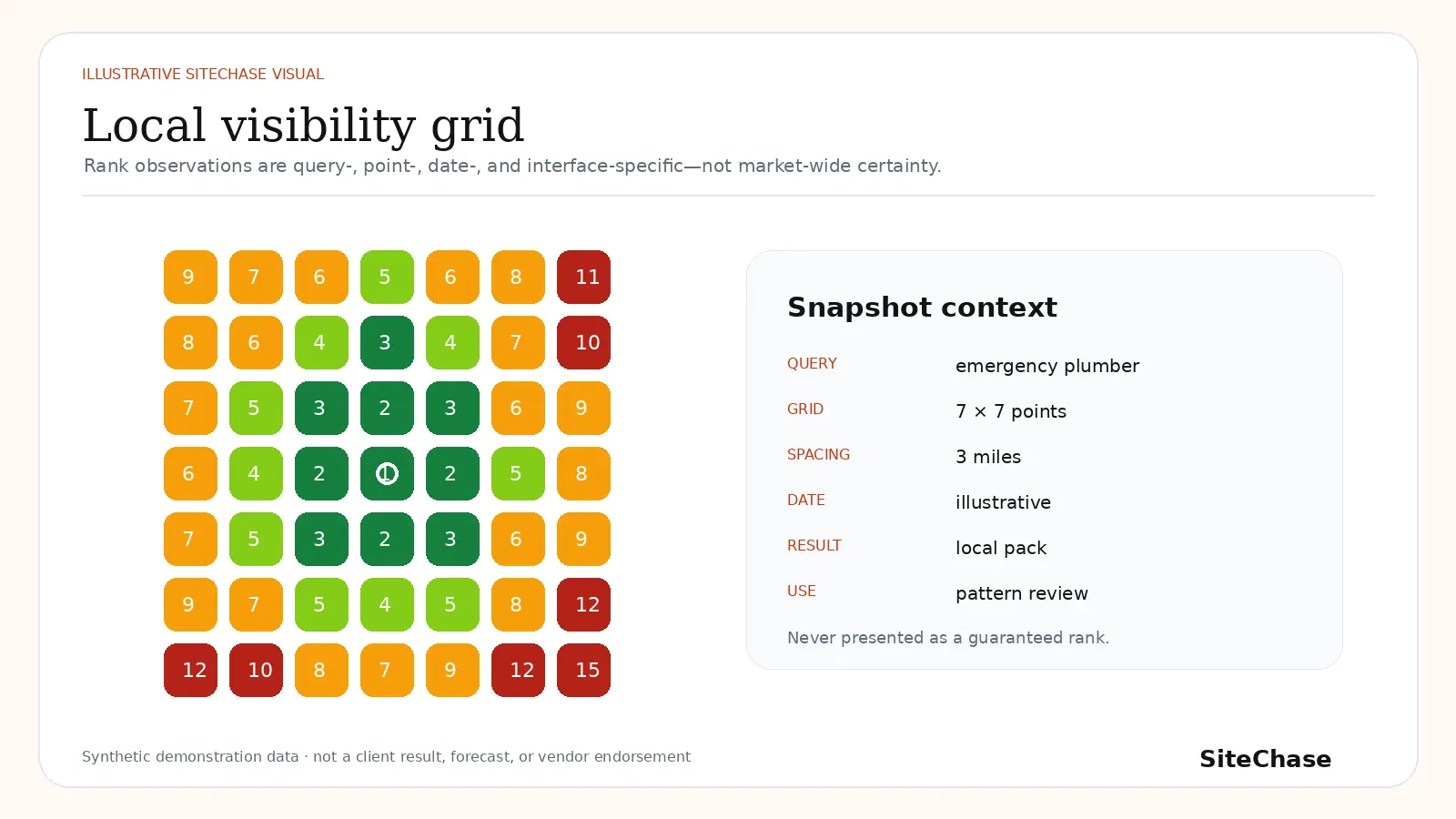
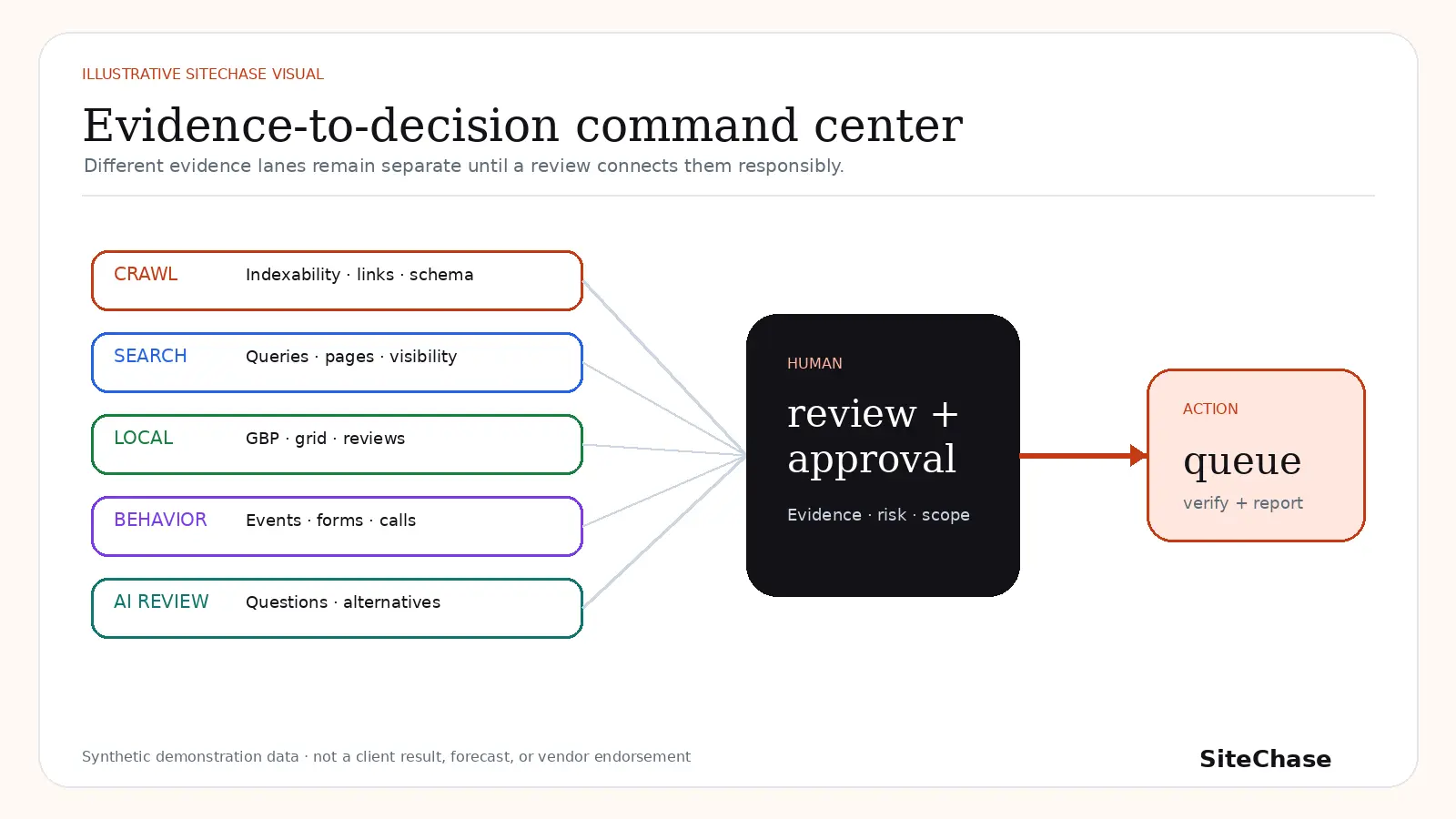
Synthetic SiteChase visuals. Local rank snapshots are query-, location-, date-, and tool-specific; they are not market-wide visibility claims.
A practical first 30, 60, and 90 days.
Confirm and prioritize
- Verify business facts and conversion definitions
- Establish evidence baselines
- Validate priority technical findings
- Prepare a contained approval queue
Implement safely
- Preserve before states
- Apply small approved batches
- Verify rendered and stored results
- Record rollback paths
Review and refine
- Compare like-for-like evidence
- Report completed work separately from outcomes
- Reprioritize the next queue
- Identify only verified proof candidates
A decision document
Evidence, limitations, priorities, dependencies, approval needs, and a realistic next sequence.
A promise of rankings or leads
The audit identifies supportable opportunities. Results depend on implementation, competition, search systems, business operations, and many factors outside SiteChase’s control.
See what the first useful decisions could be.
Request a claim-safe review built around your actual website, services, and local market.